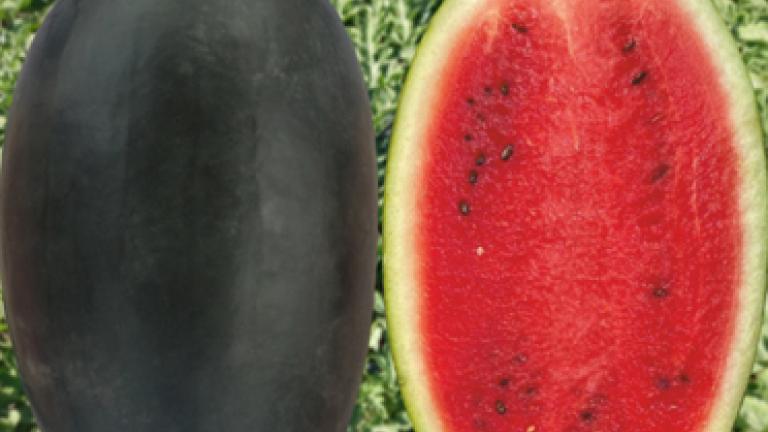
Land selection - Soils with good nutrition (medium soil, loam to sandy loam). The soil must be having excellent drainage history. If possible use the land with a previous crop other than Cucurbitaceae.
Land should be well prepared. 1-2 deep ploughing followed by 3-4 rounds of harrows to get fine tilt.
Before the final harrow, apply 8 to 10 MT well-decomposed FYM/acre along with 1kg Trichoderma for controlling soil-born fungus.
Seed Treatment-rate of timing/ chemical
Seeds are treated with Carbendazim 2g + Thiram 2 g per Kg of seeds.
Sowing Time
Late Winter, Early Summer, Summer
Sowing method
Seed Rate: 300 - 350 g per acre.
Sowing: Direct in the main field (it can also be transplanted. Seedlings at 4 leaves or 20 days old are planted)
Spacing: Row to Row and Plant to Plant – 120 × 30 cm (Single Row) or 240 × 30 cm (Double Row)
Fertilizer dose with timing
Total N:P:K requirement @ 80:100:120 kg per acre.
Dose & Timing:
Basal Dose: Apply 50% N and 100% P, K as basal dose during final land preparation.
Top Dressing: 25% N at 30 days after sowing and 25% N at 50 days after sowing.
Weed Control- Chemicals with doses and timing
Timely weed removal is very important, need-based hand weeding can be done to ensure a healthy crop. To complete this operation before fruit set
Diseases & Pest control- Chemicals with doses and timing
For effective crop, control applies fungicide as per recommendation from the Department of Agriculture (plant protection) to control Damping-off, Downey Mildew, Powdery Mildew, and other fungal diseases. Apply recommended insecticide to control sucking pests, fruit flies, and any other insects. Insecticide spray should not be done at the flowering stage (25 - 45Days) to enable honeybee activities for pollination.
For watermelon crop leaf minor, thrips, and the fruit fly are major insects. While Downy Mildew, Powdery Mildew, Wilt, Anthracnose, and Gummy Stem Blight are the major diseases. Timely control of insects and diseases will help to achieve excellent crop growth. Do not spray during the peak pollination period.
Irrigation Schedule
It needs regular irrigation. The irrigation interval and quantity need to fix to avoid fruit cracking.
In light soil and summer season the irrigation frequency should be more.
Harvesting
Harvest the fruit at the time of physiological maturity. Date of maturity or days after sowing( ͠ 75-80 days)
The maturity of watermelon can be judged by the following steps:
1. A dead tendril attaches to the vine,
2. Dull appearance of the fruit compared to their slick appearance,
3. Maturity is also judged by metallic sounds,
4. After harvesting fruits should not be left long in the sun otherwise sun scaled may develop
Features:
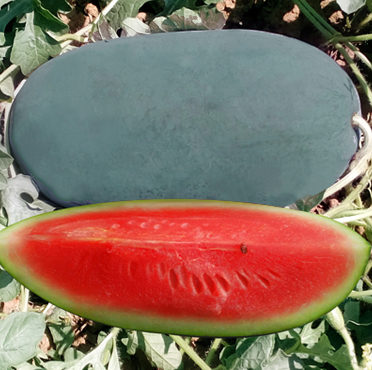
TSS 11.5%
Good yield potential
Prolific fruit set
Solid and attractive high sweetness fruit
Extra strong rind suitable for long-distance transportation
Watermelon
Sugar Queen
Features :
Sweetness :TSS 12% to 14%
Prolific fruit set & good yield.
Durable rind good for long distance transportability
Very good shelf life
Watermelon
SHERSHAAH
Watermelon
Nadiya Rani
Features:
TSS 13.5%
Good yield potential
Very good fruit setting
Good crispiness and compact fruits
Good rind thickness and suitable for long-distance travel
Watermelon
Happy Family (Seedless)
Features :
Seedless Watermelon (No visible black seeds)
High Sweetness: TSS 13% to 14%
Red flesh with good flavor and crisp
Very good rind thickness long distance transportability
Very good shelf life
Watermelon
JUBILI KING
Features:
Sweetness: TSS 10% to 11%
Prolific fruit set & good yield.
Durable rind good for long distance transportability
Watermelon
Dragon King
Features :
Sweetness : TSS 10% to 11%
Prolific fruit set & good yield.
Durable rind good for long distance transportability
Watermelon
Augusta
Features :
Sweetness : 11% to 12% brix
Uniform fruit size
Very good adaptability
Good for Long Distance transportability
Watermelon
WMT 20806
Watermelon
WMT 20808
Watermelon
Sartazz
Features:
TSS 11.5%
Good production capacity
Solid and sweet fruit of choice
High fruit-bearing capacity
Strong rind and suitable for long-distance transportation